When we talk about a political leader’s approval rating, we mean the percentage of survey-respondents (usually adult citizens or likely voters) who say they “approve” of how that leader is doing their job (or handling a particular responsibility), versus those who “disapprove.” For a high-visibility, controversial figure like Trump — businessman, former and current US President, and global personality — approval ratings are especially scrutinized, often reflecting reactions to his policies, public behavior, and current events.
Approval ratings matter because they influence political power, public discourse, future elections, and the perceived legitimacy of decisions. For Trump, these ratings have fluctuated widely over the years due to economic conditions, social issues, foreign affairs, domestic policies, and events that shape public sentiment.
Recent Approval Ratings: 2024–2025 Snapshot
2024 (Post-election / Pre-second term transition)
- According to a poll by Marquette Law School conducted Dec. 2–11, 2024, Trump’s retrospective approval (i.e. how people judged his prior term) was 53% approve / 47% disapprove. marquette.edu
- In that poll, respondents approved 49% vs 51% disapproval of his handling of cabinet appointments. marquette.edu
This showed modest public support shortly after he returned to prominence post-election.
2025: Fluctuations and Decline — Key Polls & Findings
- A July 2025 national poll by Marquette Law School found Trump’s approval was 45% approve / 55% disapprove. marquette.edu+1
- In that same poll, approval among Republicans remained very high (~86%), but among independents it was much lower (~38%), and among Democrats ~7%. law.marquette.edu
- Opinion on specific issues was more negative than positive: for example, on matters like the economy, international conflict, and tariff/inflation policies many adults disapproved of his handling. law.marquette.edu+1
- A poll by Pew Research Center in August 2025 found Trump’s job approval rating at 38% approve / 60% disapprove. Pew Research Center
- Among his own 2024 voters, 85% still approved — but support among younger voters (under 35) had fallen significantly. Pew Research Center
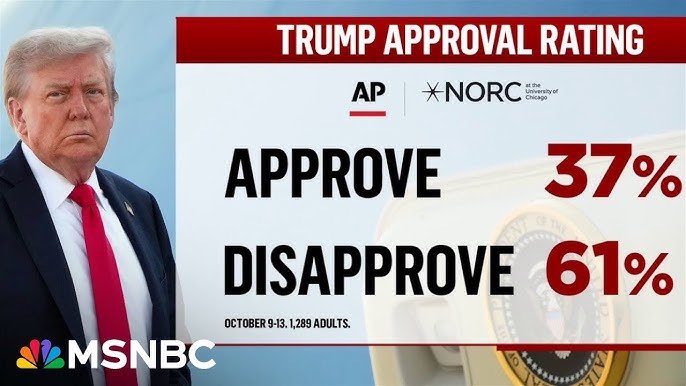
- According to a November 2025 poll by Gallup, his approval dropped to 36% approve / 60% disapprove, the lowest level in his second term so far. Forbes+1
- Another survey (conducted late November 2025 by YouGov / The Economist) found only 38% approval and 57% disapproval, giving a net approval (approve minus disapprove) of –19 — tied with his worst since returning to office. YouGov
Thus, by late 2025, most major polls suggest that roughly 35–40% of U.S. adults approve of Trump’s performance, while around 55–60% disapprove — indicating a substantial negative tilt in national sentiment.
Trends & Patterns: Why Has Support Declined?
1. Polarization and Party Lines
- Approval remains high among Republicans: in the July 2025 Marquette poll, ~86% of Republicans approved; but among independents and Democrats the numbers were much lower (38% and 7%, respectively). law.marquette.edu+1
- This suggests that for many Americans, support for Trump is increasingly partisan — stable within his base, but eroding among centrists and opposition party.
2. Economic & Policy Issues — Inflation, Economy, Living Costs
- Surveys show strong disapproval of Trump’s handling of the economy, tariffs, inflation, and cost of living. law.marquette.edu+2Al Jazeera+2
- For many voters, economic pressure and high living costs translate into dissatisfaction with leadership — historically a key factor affecting approval ratings.
3. Broader Issues — Foreign Policy, Immigration, Social Policies
- In multi-issue polls, approval on immigration, foreign policy, and international conflicts often lags or is negative. law.marquette.edu+2The Guardian+2
- When substantial portions of the public view foreign-policy stances or social issues unfavorably, it reflects in overall job ratings.
4. “Shock Events,” Scandals, Congressional Gridlock, Public Mood
- Major events — such as government shutdowns, contentious policies, or economic downturns — tend to lower support across voter groups. For instance, the drop to 36% in the Gallup poll coincided with the record-long government shutdown in late 2025. Forbes+1
- Public perception of national direction (economy, cost of living, democracy, foreign standing) influences approval more broadly than just single policies. The Guardian+2The Business Standard+2
What Approval Ratings Reveal — and What They Don’t
What they reveal:
- Rough public mood about the presidency — whether people broadly support or reject the leader’s direction.
- Electoral risks and political capital for future elections or midterms.
- Where a leader stands on key public issues — economy, social justice, foreign policy — in the eyes of the public.
- The strength and loyalty of one’s political base, especially when approval among supporters remains high even when overall rating is low.
What they don’t always reveal:
- Depth or intensity of support (approve vs. strongly approve). A 40% “approve” can include mild approval or strong support — the poll may not differentiate.
- Why people approve or disapprove (some may like certain policies, dislike others).
- Future changes: ratings can bounce back based on developments (economy, events, leadership decisions).
- Demographic breakdowns beyond party identification: age, geography, race, socioeconomic status — which can significantly influence results.
Historical Perspective: How Trump’s Current Standing Compares to Past Terms
- During his 2025–second term, Trump’s approval dips into the mid-to-high 30% — historically a low point for U.S. Presidents at a similar stage. YouGov+2Forbes+2
- In earlier eras (e.g. first term, or before 2025), his approval sometimes reached low-to-mid 40% to mid 50%, depending on timing and poll. For instance, the December 2024 Marquette poll showed 53% retrospective approval. marquette.edu
- But given increasing polarization, shifting demographics, and media scrutiny, sustained ratings above 50% appear harder to maintain — especially when multiple national challenges accumulate.
What Might Influence Future Approval Trends for Trump
Looking ahead, several factors could shift approval ratings up or down:
- Economic performance: If inflation eases, cost-of-living stabilizes, and job growth continues — public support might improve.
- Effective policies or crisis management: Quick, popular responses to crises (economic, international, social) tend to boost approval.
- Public perception and media environment: Messages, communication style, transparency, and framing can influence opinions; media narratives matter.
- Opposition performance & political alternatives: If opposition parties or rival candidates fail to present credible alternatives, or are themselves unpopular, that may benefit Trump.
- Demographics & generational shifts: Younger voters, minorities, urban vs rural divides — changes in voter composition may gradually reshape overall sentiment.
- Major events (foreign policy, global crises, domestic issues): Wars, immigration crises, public health, social justice — events outside economics often strongly impact approval.
Conclusion: A Mixed Picture — A Polarizing Leader with a Deep-Set Core Base and Widespread Disapproval Among Others
Donald Trump’s approval rating in late 2025 paints a complex and divided picture. On one hand, he retains strong support from his base (Republican voters), and among certain demographics continues to garner loyalty. On the other hand, a majority of the U.S. public — including many independents and younger voters — express disapproval.
His approval metrics suggest that his presidency remains deeply polarizing: for a sizeable portion of Americans he represents stability, strong identity politics, and a certain worldview; for many others, his policies, style, and broader direction raise concern.
Whether his approval will rebound — or continue to decline — depends on a mix of economic realities, policy outcomes, public trust, and unforeseen events.
Initial Approval and Early Years
- When Trump first assumed office (January 2017), his approval rating started at around 45% approve / 45% disapprove. Wikipedia+1
- Over his first years, his approval fluctuated — for example, according to a widely used poll aggregator, his average approval over the first term settled around 42.8%, with disapproval at 53.4%. realclearpolling.com+1
- Year by year, for first term:
– 2017: ~ 40.5% approve, 54.0% disapprove realclearpolling.com+1
– 2018: ~ 42.5% approve, 53.2% disapprove realclearpolling.com
– 2019: ~ 43.4% approve, 53.3% disapprove realclearpolling.com
– 2020: ~ 44.4% approve, 53.1% disapprove (note: 2020 had many extraordinary events globally and in U.S.) realclearpolling.com+1 - As a result, according to one analysis, the first-term average job approval of Trump was about 41.1%, lower than any other modern U.S. president’s four-year average. Gallup.com+1
This pattern shows that although Trump had a strong partisan base, he never achieved high sustained majority approval; instead his approval remained in a narrow band around 40–45%, with disapproval generally higher.
Factors During First Term That Influenced Ratings
Some of the recurring factors that affected his approval during first term:
- Economic fluctuations, tax reforms, and economic policy impacts.
- Polarizing decisions on immigration, foreign policy, and social issues.
- Public controversy around events such as impeachment proceedings, national protests, and global crises.
- A highly polarized political environment — meaning approval tended to split sharply along partisan lines rather than centrist consensus.
Return to Office & Second Term (2025 – present)
With Trump’s return to the presidency in 2025, public opinion polling resumed, and early second-term numbers reflected both optimism and caution.
Initial Phase (Early 2025)
- According to a poll aggregated by one source, at the start of his second term (late January 2025), his approval stood at 47% approve / 48% disapprove. Wikipedia+1
- In December 2024 — just after election but before inauguration — a retrospective poll by Marquette Law School showed 53% of respondents approved of how Trump handled his prior presidency, with 47% disapproving. marquette.edu
- This suggests that at that moment, there was a relative high in public sentiment — perhaps due to change in leadership and expectations.
Mid-2025 Fluctuations and Decline
- By July 2025, a new Marquette Law School poll found overall approval at 45%, disapproval 55%. marquette.edu
- Within that: Republicans overwhelmingly approved (~86–89%), while independents and Democrats showed strong disapproval. marquette.edu
- Through mid-2025, according to weekly tracking by Gallup, approval rates hovered around 40–44%. Gallup.com+1
- However, by November 2025, a Gallup poll showed approval dipped to 36%, with disapproval at 60% — the lowest of his second term. Gallup.com
Recent Low Point
- The drop to 36% approval stands out as a significant decline. Gallup.com+1
- According to polling aggregators, around late 2025 his average approval across different polls sits near 41.5% approve / 56% disapprove. PolitiFact+1
Why Is Approval So Polarized & Volatile? — Key Influences
Partisan Polarization: Base vs. Everyone Else
- As recent polls show, among Republicans, support remains very strong — for example, in July 2025, ~86% approval among Republicans, while nearly all Democrats disapprove. Independents tend to lean heavily negative. marquette.edu+1
- This means overall approval is heavily constrained by partisan identity — when the base supports, but independents and opposition strongly disapprove, the overall remains modest.
Policies & Economic Conditions: Living Costs, Economy, Trade, Inflation
- Economic issues — inflation, cost-of-living, jobs, tariffs — frequently influence approval. When people feel financially strained, displeasure rises. Recent polls indicate many Americans disapprove of his handling of such issues. marquette.edu+2PolitiFact+2
- For a president whose earlier business/rhetoric emphasized economic growth and stability, any perceived economic mismanagement can strongly dent approval ratings.
National Crises, Controversies & Public Sentiment
- Major events — domestic (e.g. social unrest, shootings) or international (trade wars, conflicts) — tend to shift public moods quickly, affecting approval. For instance, issues like foreign-policy decisions, tariffs, or social unrest have historically impacted ratings for Trump. Gallup.com+2yalibnan.com+2
- Also, Trump’s communication style, polarizing stance on immigration, social issues, and frequent controversies increase scrutiny — leading to strong disapproval among large segments of the population.
Media, Public Perception & Information Flow
- In a media-saturated environment, every decision, statement, or misstep is magnified. Polls tend to reflect both policy outcomes and public perception shaped by media coverage.
- As a result, approval ratings for politically prominent figures like Trump are not only reflections of concrete policy results but also of reputation, trust, and social narratives.
What the Numbers Show: Stability for Core Base, Weakness Among Wider Public
- Across both terms, Trump’s approval tends to stay within a narrow band: roughly 40–45% approval, with disapproval generally higher (50–60%+).
- He retains a deep core base — many Republicans and loyal supporters consistently approve, which gives him a stable floor.
- But he struggles to build a broad majority consensus. Independents, swing voters, and oppositional voters often tilt disapproval — making sustained high approval rare.
- Poll-to-poll fluctuations are often tied to external events (economy, social issues, global crises) rather than long-term structural support.
Implications: What Approval Ratings Mean for Trump’s Political Future
Political Capital and Governing Power
Low to moderate approval constrains a president’s ability to push through controversial policies, especially if Congressional support is fragmented. Persistent disapproval may embolden opposition parties, lead to gridlock, or limit willingness for compromise.
Electoral Prospects — Midterms & Beyond
Approval ratings are often correlated with midterm election outcomes. With disapproval rates above 50% and approval around 36–45%, incumbents and associated party candidates may face headwinds in elections. This could be especially relevant for the 2026 midterms.
Public Perception & Legacy
Over time, long stretches of low approval can damage legacy — even supporters may reconsider if policies don’t yield perceived benefits. On the other hand, if political or economic conditions improve, there is potential for rebound.
Dependency on Core Base vs. Broader Coalition
Given the deep polarization, Trump’s political strength increasingly depends on maintaining his core base, rather than winning over a majority of the general public. This shapes strategy — focusing on base mobilization rather than broad-based appeal.
Could Approval Bounce Back? — What Would It Take
Historically (and according to analysts), several factors might lead to a rebound:
- Economic Improvement: Lower inflation, better job market, rising wages — concrete economic relief tends to boost popularity.
- Effective Crisis Management: Smooth handling of emergencies (economic, health, security) can generate public sympathy and trust.
- Major Legislative or Policy Wins: Passage of widely popular reforms (e.g. infrastructure, social policies) could shift public opinion.
- Improved Public Messaging & Image Management: Reducing controversies, improving communication style may soften negative perceptions among moderates/independents.
- Opposition Weakness: If rival political parties or candidates fail to present credible alternatives, some dissatisfied voters may return or moderate their positions.
In other words: a rebound is possible — but likely only if multiple favorable conditions align.
Comparative Perspective: Trump vs Other Presidents
- According to historical data, the average approval rating across U.S. presidents is about 53%, while many successful presidents have maintained averages well above 50%. Gallup.com+2Kuchewar+2
- In contrast, Trump’s first-term average (≈ 41%) is among the lowest for any modern president. Gallup.com+1
- This suggests that even at steady phases, Trump’s approval base is narrower and more polarized than many past presidents — reflecting the intensely divisive social and political environment of his time.
Conclusion: A Polarizing Leader — Strong Base, But Limited Consensus
Donald Trump’s approval history demonstrates a key political reality: he remains a deeply polarizing figure. While his core supporters continue to back him strongly, a large portion of the public remains unconvinced or disapproving.
His approval rating — often hovering between 40% and 45% (sometimes lower) — reflects a stable but constrained mandate. For long-term governance, legacy, or policy ambitions, such numbers present both opportunities and challenges: loyalty from a dedicated base, but limited broader support.
Whether his approval will rebound hinges on economic conditions, policy success, public sentiment, and external events — not guaranteed, but not impossible either.
About the Author