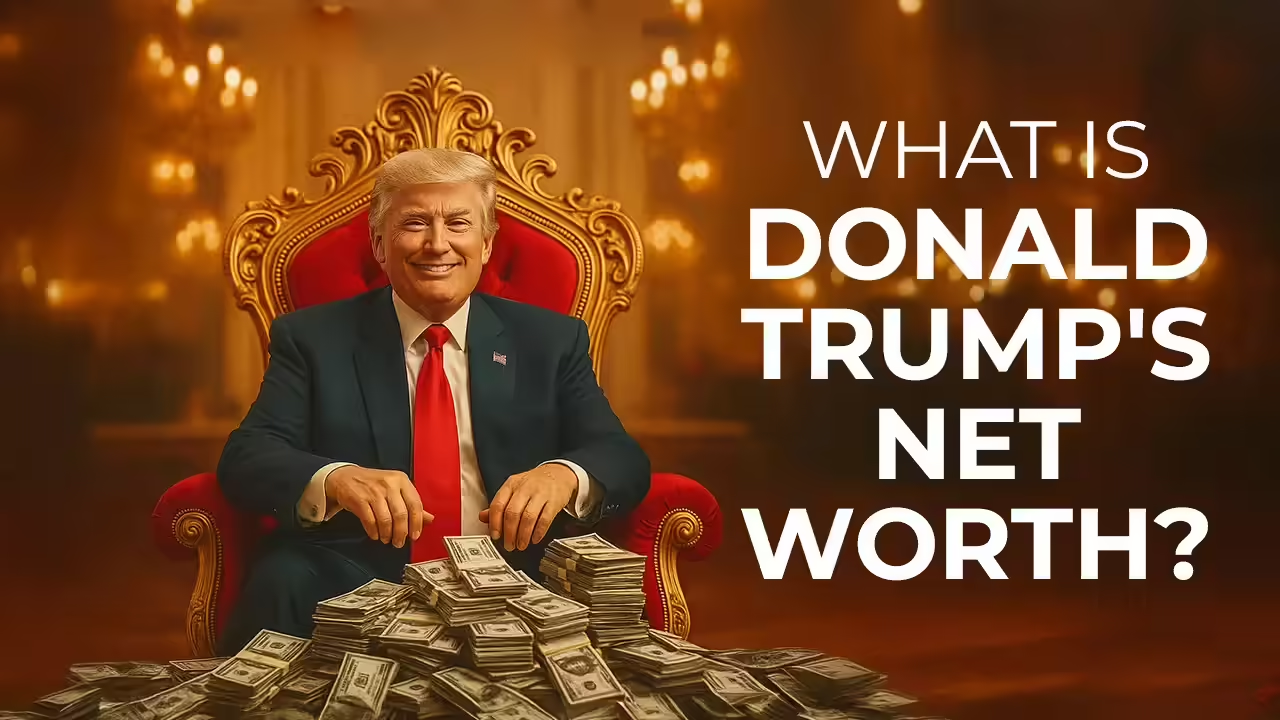
Donald J. Trump is a businessman, real-estate tycoon, media figure, and former and current President of the United States. Over decades he accumulated assets from a wide array of ventures: real estate (commercial and residential properties, office buildings, hotels, golf courses), branding and licensing deals, investments, and more recently digital-assets and social-media ventures.
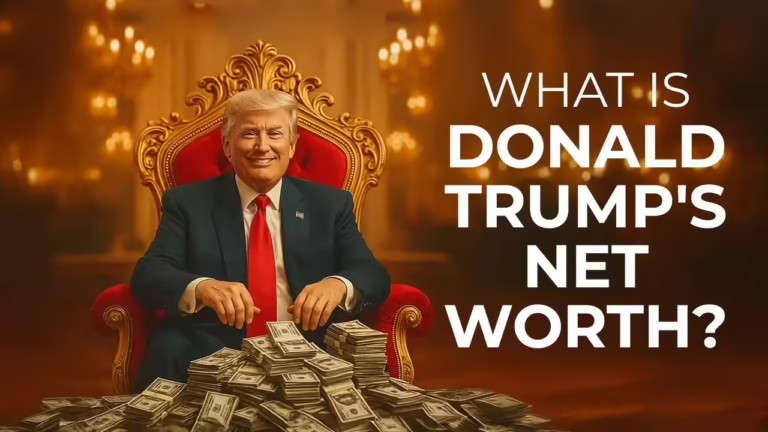
When we talk about “net worth,” we refer to the estimated total value of his assets (real estate, business holdings, cash, investments) minus his liabilities (debts, obligations, and legal liabilities). Because many of Trump’s assets are private, illiquid, or subject to market fluctuations (real estate valuations, company valuations, crypto price swings), any figure is necessarily an estimate — and subject to large uncertainty.
Recent Estimates of Trump’s Net Worth
- According to a recent profile by Forbes, as of December 2025, Trump’s net worth is listed at US $6.3 billion. Forbes
- Other analyses in 2025 have put the number higher: depending on assumptions about assets (especially newer ventures), some valuations reach ≈ US $7.3 billion. Forbes+2Forbes+2
- But past volatility shows how changeable the figure can be: there were periods when valuations dropped — for example, due to declines in the value of his media-company stock — reducing his net worth significantly. Forbes Australia+2Forbes Australia+2
Because of all these swings, most reliable sources treat Trump’s net worth as a range rather than a fixed number — somewhere between US $6 billion and US $7.5 billion, depending on market conditions and valuation methods.
What Makes Up Trump’s Wealth — At a Glance
Trump’s portfolio is diversified. Key components include:
- Real estate holdings, buildings, and properties — commercial and residential buildings, office skyscrapers, apartments, hotels, resorts, and golf courses. www.ndtv.com+2Forbes+2
- Golf courses, resorts, clubs, leisure properties — including clubs and resorts in the U.S. and abroad. Forbes+2www.ndtv.com+2
- Businesses, licensing, brand-related ventures — Trump branding, licensing deals, and business operations that yield revenue. Forbes+1
- Newer ventures — crypto, media, digital assets — in recent years, a substantial portion of his wealth comes from cryptocurrency investments and digital-asset projects. Forbes+2Forbes+2
- Liquid assets and investments — cash, investments, and other more liquid holdings, which help in smoothing out volatility from real estate or business valuations. Forbes+2Forbes+2
Because of this mix, shifts in any one sector — e.g. a slump in crypto values, or a drop in commercial real-estate prices — can significantly affect the estimated net worth.
How Trump’s Wealth Changed Over Time
Trump’s wealth has gone through many cycles, reflecting the ups and downs of his business ventures and broader economic conditions. Some highlights:
- Earlier in his career, Trump built considerable real-estate holdings and developed his brand. Over decades, he amassed a sizable property portfolio. MoneyWeek+1
- In some years (especially during downturns or economic crises) his wealth dropped. For example, during downturns in real estate markets. MoneyWeek+1
- A major shift occurred in the 2020s: beyond real estate, Trump embraced newer ventures — media, licensing, and especially cryptocurrency/digital-asset investments. Forbes+2Forbes+2
- According to recent reporting: Trump’s “crypto-kingdom” now accounts for a large portion of his net worth — reflecting earnings and investments in digital assets. Forbes+2Forbes+2
- The value of his media-company holdings (and associated tokens/assets) caused substantial gains — but also volatility, meaning that swings in market sentiment or regulatory scrutiny can push his net worth up or down. Forbes+2Forbes+2
Why It’s Hard to Know “Exactly” How Rich He Is
There are several reasons besides normal market fluctuations that make any net-worth number for Trump uncertain:
- Many assets are privately held — properties, buildings, holdings in companies, partnerships. Their true market value may differ from public estimates.
- Asset valuations depend on assumptions: e.g. what discount rate to use, how to value future earnings, how to treat debt, how to estimate income from licensing, resorts, etc.
- Volatility in newer assets — crypto & digital ventures — cryptocurrency values can swing dramatically in short periods, which makes the portion of wealth tied to such assets volatile.
- Liabilities, debts, and legal risks — legal cases, lawsuits, debt payments or penalties may subtract significantly from gross assets. If liabilities grow, net worth shrinks.
- Disclosure limitations — Trump does not publicly release full verified financial statements; much of the valuation comes from journalistic and analyst estimates, which may vary.
Because of all this, sources such as Forbes or Bloomberg regularly update their estimates, and different sources may report different numbers.
What Recent Events Have Done to His Net Worth
Recent years — especially around 2024–2025 — have brought major changes to Trump’s estimated net worth:
- According to one recent estimate, by September 2025 Trump’s net worth had climbed to roughly US $7.3 billion. This increase was driven largely by gains in cryptocurrency holdings and his business ventures. Forbes+1
- Much of the gain came from digital-asset investments: memecoins, stablecoins, other crypto-linked ventures, and liquidity from asset shifts. Forbes+2Forbes+2
- However, there has also recently been downward pressure: in late 2025, some valuations dropped (for example, his media/tech business stock fell), cutting his estimated net worth by a noticeable amount. Forbes Australia+1
- As a result, while many sources still rank him among the world’s richest, the margin and composition of his wealth remains volatile and under scrutiny.
Broader Implications — What Trump’s Wealth Reflects
Trump’s net worth (and its fluctuations) highlight several broader trends and issues:
- Real-estate wealth versus modern asset classes: Trump’s path shows how traditional real-estate-driven fortunes can morph in the modern era by embracing newer, high-volatility asset classes like crypto.
- Risks of concentration: When a large portion of wealth depends on volatile or speculative assets (crypto, media ventures), fortunes can rise — but also fall sharply with market swings.
- Transparency and valuation difficulties: Wealth built across different sectors (real estate, private companies, crypto) makes public estimation difficult; without full disclosure, valuations remain speculative.
- Impact of politics and public profile: As a highly visible public and political figure, Trump’s wealth is under intense scrutiny; changes in public sentiment, regulation or legal challenges can impact valuations or business prospects.
- Legacy and longevity considerations: While real-estate assets tend to be long-term, digital ventures may not; what his “true wealth” will mean in the long-run depends on how sustainable and diversified his investments remain.
During the 1980s, Trump built a public image as a flashy, ambitious real-estate developer dominating New York. This was the era of the Trump Tower boom, casino ownership, and large Manhattan development deals. His wealth at the time was almost entirely tied to property value — skyscrapers, luxury properties, and growing recognition of the “Trump” brand.
This period shaped the foundation of his long-term fortune: land ownership, multi-use towers, and leveraged financing.
1990s Challenges: Debt, Recession, and Casino Troubles
The early 1990s recession hit the commercial real-estate market hard. Trump faced large debts from casinos, hotels, and construction projects. Several corporate entities went through restructuring or bankruptcy.
This decade revealed a key pattern central to Trump’s financial story:
He often leveraged debt aggressively — and used restructuring to survive downturns.
It is one of the major reasons his net worth has fluctuated dramatically from era to era.
Diversification Beyond Real Estate
The Branding Era (1990s–2015)
After the financial pressures of the early 90s, Trump shifted increasingly toward business ventures that required less capital and offered faster cash flow, such as:
- Licensing the Trump name to hotels, towers, and merchandise
- Opening or branding golf courses
- Entertainment ventures
- Partnerships and management arrangements
This gave rise to the idea of “Trump” as both a businessman and a brand.
Brand licensing deals became a significant revenue source, offering millions of dollars in fees without the need to own or develop costly physical buildings.
Television and Media Wealth
“The Apprentice” dramatically increased Trump’s visibility. The show also delivered:
- Annual salaries
- Producer earnings
- Brand power that boosted other businesses
This media exposure strengthened his financial expansion in the 2000s.
Trump’s Post-Presidency Wealth Evolution
The 2020s Shift Toward Digital & Crypto Assets
One of the biggest evolution points in Trump’s modern financial profile is the rise of digital assets.
This era includes:
- Investments in cryptocurrency
- Growth of digital-asset holdings
- Media company ventures and token-related valuation swings
Digital investments tend to fluctuate far more than real estate, which explains why estimates of Trump’s net worth can shift by billions depending on the week or month.
Golf Courses and Luxury Resorts in the 2020s
Trump’s golf properties remain major components of his asset portfolio.
Golf resorts have unique financial characteristics:
- High operating costs
- Steady cash flow
- Strong brand loyalty
- Long-term land value appreciation
These assets may not grow as quickly as crypto or digital ventures, but they provide long-term stability — a counterbalance to volatility elsewhere.
Why Trump’s Wealth Is Difficult to Measure
Private Assets Don’t Have Public Values
Many of Trump’s properties and companies are privately held, meaning:
- No public earnings reports
- No market-driven valuation
- No audited public balance sheets
Analysts must estimate asset values based on similar properties, expected revenues, and market conditions.
Debt and Leverage Complicate The Picture
Trump has historically used loans, refinancing, and restructuring aggressively.
Two properties could have the same market value — but their net contribution to wealth may differ dramatically depending on:
- Interest rates
- Loan size
- Collateral
- Liabilities
- Pending legal outcomes
Thus, gross value does not equal net worth.
The Role of Lawsuits, Fines & Legal Liabilities
Trump has faced numerous ongoing legal challenges, which can affect wealth in terms of:
- Direct financial judgments
- Legal fees
- Restrictions on business operations
- Impact on investor confidence in associated companies
Even when liabilities do not immediately reduce cash flow, they can depress valuation estimates for analysts.
Comparison to Other Billionaires
Trump’s wealth differs significantly from tech billionaires, who often have:
- Liquid stock holdings
- Transparent public ownership records
- Rapid value growth tied to technology markets
In contrast, Trump’s wealth is based on:
- Illiquid real estate
- Private ventures
- Asset-heavy projects (land, towers, resorts)
- High-volatility digital ventures
This is why his net worth estimates vary more widely than those of most billionaires.
Trump’s Wealth Philosophy
Across decades of interviews, books, and decisions, Trump’s wealth philosophy emphasizes:
- Leverage — using debt to control larger assets
- Brand power — turning name recognition into income
- Visibility — believing publicity increases business value
- Durable assets — especially land and properties
- Risk tolerance — entering high-volatility industries
This philosophy has produced both substantial gains and dramatic downturns.
Legacy Value: How His Wealth Will Be Viewed Historically
Whether admired or criticized, Trump’s financial journey will be studied for decades because:
- He blended politics, business, and media in unprecedented ways.
- His wealth strategies — especially branding — influenced future entrepreneurs.
- His transition from real estate to digital assets mirrors changes in the global economy.
- His net worth became a political narrative, shaping public perception.
In the long run, Trump’s most valuable assets may not be only financial — but the systems, brands, and cultural impact he built.
If You Want More…
I can extend this article further with:
✅ A year-by-year net worth timeline (1980–2025)
✅ A detailed breakdown of his real estate empire
✅ An extended analysis of his crypto-related wealth
✅ A comparison with other U.S. presidents’ wealth
Just tell me what you want:
“timeline”, “real estate breakdown”, “crypto section”, or “compare”.
Conclusion
Estimating the net worth of a figure like Donald Trump is inherently complex. Current public estimates place him in the ballpark of US $6–7.3 billion — though swings in asset valuations, especially in newer sectors like cryptocurrency and media, mean that this number could shift substantially in a short time.
His wealth today is a hybrid — rooted in decades-long real-estate investments, but increasingly driven by modern, high-volatility ventures like crypto and media. What remains clear is that whether viewed through the lens of traditional business or modern digital assets, Trump remains one of the wealthiest and most financially complex public figures in the world.
About the Author